 Image 1 of 1
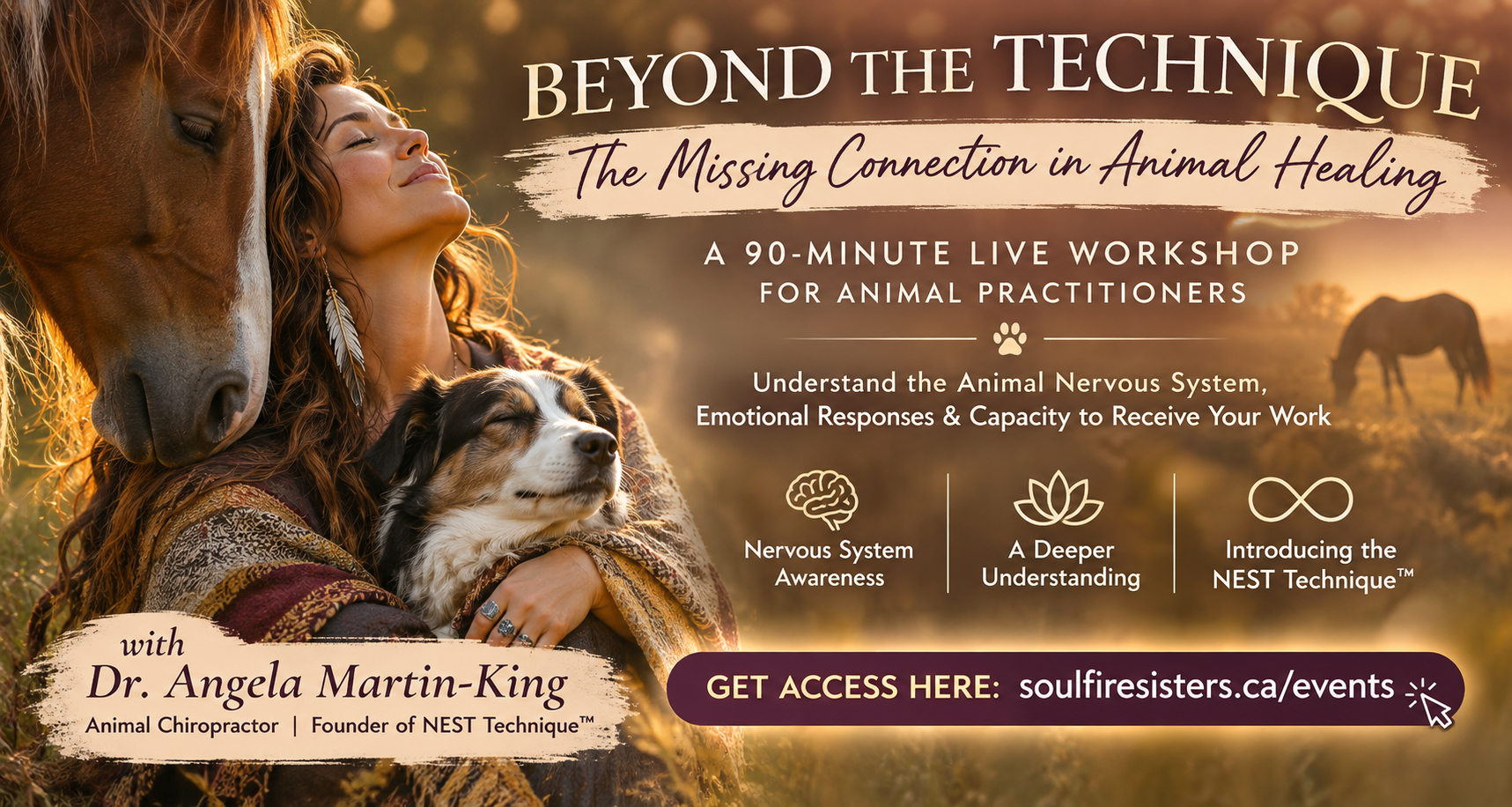
🐶 🐾 BEYOND THE TECHNIQUE 🐾 The Missing Connection in Animal Body Work & Healing🐴 Monday, November 30th 2:00 PM – 3:30 PM EST
🐾 BEYOND THE TECHNIQUE 🐾 The Missing Connection in Animal Body Work & Healing
A 90-Minute Live Workshop for Animal Practitioners
What if the next breakthrough in your animal practice isn’t another technique, but learning to recognize what the animal’s nervous system has been telling you all along?
You’ve studied anatomy, learned techniques, developed your hands, and spent countless hours helping animals feel and move better.
But you’ve probably encountered animals that leave you wondering…
🐴 Why does one horse respond beautifully while another becomes guarded, restless, or completely disengaged?
🐕 Why does a dog seem to relax during treatment, only to return to the same patterns a few days later?
🐾 Why do some animals release tension almost immediately while others seem unable to let go, regardless of how skilled your hands are?
💫 Why can you sometimes FEEL something happening in an animal’s body that your training hasn’t taught you how to explain?
And perhaps the biggest question…
What are you missing when everything you’re doing SHOULD be working, but the animal isn’t responding the way you expected?
These are the questions that led me beyond traditional chiropractic, rehabilitation, and bodywork, Spinal Flow for animals and ultimately to developing the NEST Technique™.
Because after decades of working with animals, I’ve learned something important.
The technique is only part of the conversation. The animal’s nervous system determines how that conversation unfolds.
And the practitioner is part of that conversation too!
🌿 THE MISSING PIECE IN ANIMAL HEALING
Animals don’t experience the world the way humans do.
Their survival instincts, sensory awareness, emotional experiences, and nervous system responses influence how they receive touch, movement, therapeutic intervention, and even our presence.
An animal that appears calm may actually be shut down.
An animal that moves away may be communicating something entirely different from resistance.
And an animal that isn’t showing an obvious response may still be processing changes beneath the surface.
When you learn to recognize these differences, you begin to see possibilities that weren’t available through technique alone.
This is where science, intuition, and the art of healing begin to meet.
And it’s where your work can become extraordinary.
🧠 WHAT WE’LL EXPLORE
1. The Animal Nervous System: What’s Really Happening Beneath the Behaviour?
We’ll explore how animals process physical, emotional, and environmental stress, and why their nervous system responses can dramatically influence your results.
You’ll discover:
* How survival responses influence an animal’s ability to receive therapeutic work.
* The differences between relaxation, regulation, and shutdown.
* Why animals can mirror and respond to the nervous system states of the people around them.
* How previous experiences, injuries, and emotional stress can influence current responses.
* Why practitioner presence and co-regulation matter more than many practitioners realize.
You’ll begin recognizing what the animal is communicating before you ever place your hands on them.
2. Beyond Anatomy: Learning to Feel What Your Hands Haven’t Been Taught
Most animal practitioners are trained to identify physical structures, restrictions, tension, and movement patterns.
But what happens when the body is communicating through more subtle changes?
We’ll explore:
* The relationship between physical tension, emotional holding, and nervous system protection.
* Why the same contact can produce completely different responses in different animals.
* How pressure, positioning, angles, and timing influence reception.
* Why more pressure or more technique isn’t necessarily more effective.
* How to recognize changes in tone, breath, movement, and responsiveness.
* The difference between working ON an animal and working WITH its nervous system.
You’ll also be introduced to the principles of NEST Technique™ (Neuro-Emotional-Somatic-Trust) and how this approach expands the way we assess, connect with, and support animals.
3. Reading the Response: Knowing What to Do Next
This is where many practitioners encounter their greatest uncertainty.
You know what you’ve been trained to do.
But what happens when the animal doesn’t respond according to the textbook?
We’ll explore:
* How to distinguish ordinary movement from meaningful changes in nervous system state.
* Why some animals respond immediately while others require more time and different approaches.
* How to recognize when an animal is becoming overwhelmed.
* Why knowing when to pause can be as important as knowing what to do.
* How to develop greater confidence in your observations and intuitive awareness.
* Why ongoing mentorship and practical experience are essential to developing these skills.
Because recognizing a response is one skill. Understanding what it means and knowing how to respond is another.
And that difference can transform your practice.
✨ INTRODUCING THE NEST TECHNIQUE™
Neuro-Emotional-Somatic-Trust a technique to help the whole animal.
NEST was born from my experience in chiropractic, animal rehabilitation, nervous system work, and the deeper connections I’ve witnessed between the physical, emotional, and energetic aspects of healing.
It brings together three essential foundations:
🧠 The Science: Understanding nervous system function, stress responses, and how the body communicates through posture, movement, and physiological changes.
💚 The Philosophy: Recognizing the body’s innate intelligence and creating the conditions that support its own capacity for healing.
✨ The Art: Developing the sensitivity, intuition, precision, and presence to recognize what each animal needs in that moment.
NEST isn’t about replacing the skills you’ve already spent years developing. It's actually about weaving them together in a more cohesive way. (greater impact too)
It’s about expanding what you can perceive, understand, and offer.
And perhaps discovering that some of the things you’ve been intuitively sensing all along have a place in your professional practice.
This workshop will give you enough to start seeing animals differently… and enough to realize what it actually takes to do this well.
🗓️ WORKSHOP DETAILS. Beyond the Technique: The Missing Connection in Animal Healing
Monday, November 30th 2:00 PM – 3:30 PM EST
Investment (Sliding Scale):
$37 USD — Live workshop
$47 USD — Live workshop + workbook
$57 USD — Live workshop + workbook + recording access
Designed for practitioners ready to expand into animal work or deeper into the connections between human and animals.
If this work has been calling you, this is your entry portal. You can keep guessing with animals… or you can actually learn from an expert.